
How many years did Ram stay in Chitrakoot?
There are two answers, and both are part of how Chitrakoot is remembered. We give them side by side, with respect, and without argument.
In Chitrakoot's tradition
About 11 to 11½ years. The district website's Chitrakoot page says about eleven and a half years (elsewhere on the same page, "nearly eleven"), and MP Tourism gives eleven of the fourteen years, "according to folklore".
In the Valmiki Ramayana
No number. After Bharat's visit Ram decides to leave Chitrakuta and goes to the hermitage of the sage Atri (Ayodhya Kanda 117). Later the text says ten years passed among the hermitages of the sages in the forest beyond (Aranya Kanda 11).
Read on its own, the Valmiki text points to a shorter stay at Chitrakuta itself. Local tradition, the district and the state tourism department speak of about eleven or eleven and a half years. Pilgrims honour Chitrakoot as the place of Ram's exile either way, and the places below are where that memory lives.
What do the texts say happened at Chitrakoot?
In the Valmiki Ramayana, Chitrakuta is where Ram, Sita and Lakshman build a leaf hut and live in exile, where Bharat comes to take Ram back, and where the crow episode takes place. The table gives each episode with its kanda and sarga, and the place tradition links it to. We summarise; we do not quote the Sanskrit.
| What the text says | Where in the text | Where tradition places it |
|---|---|---|
| At Prayag, the sage Bharadvaja tells Ram to live on Chitrakuta, a sacred hill where sages live. The Sanskrit puts it "ten krosha" away; translators read the distance differently. | Ayodhya Kanda 54 | The road from Prayagraj to Chitrakoot |
| Lakshman builds a leaf hut, and they enter it after a house-purification rite. | Ayodhya Kanda 56 | Ram's hut — local traditions differ on the exact spot |
| Ram shows Sita the hill and the Mandakini, says he is happier here than in Ayodhya, and says he does not long for the kingdom. | Ayodhya Kanda 94–95 | Kamadgiri, the Mandakini and Ramghat |
| Bharat comes, with the queens and the people of Ayodhya, to take Ram back. Ram gives him his sandals; Bharat sets them on a royal elephant's head, then carries them on his own head as he leaves. | Ayodhya Kanda 112–113 | Bharat Milap Mandir, where rocks are believed to have melted at the brothers' meeting |
| Ram leaves Chitrakuta: the memory of the visit stays with him, and the army's horses and elephants have spoiled the place. He goes to the sage Atri. | Ayodhya Kanda 117 | The forest road to Sati Anusuya |
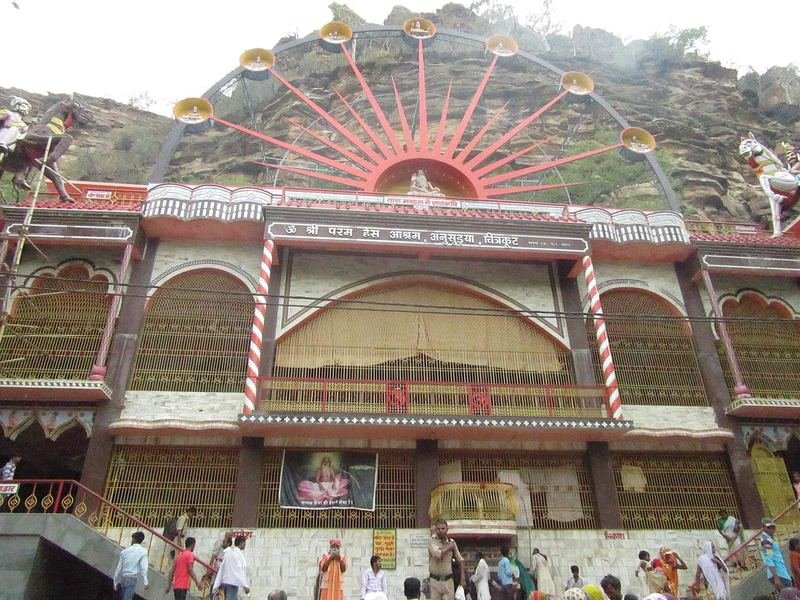
| Atri's wife Anasuya is praised: in a ten-year drought she brought forth fruit and roots and made the Ganga (Jahnavi) flow there. She counsels Sita and gives her garments and ornaments. | Ayodhya Kanda 117–119 | Sati Anusuya ashram; local belief holds that the river she brought is the Mandakini, which rises there |
| Ten years pass among the hermitages of the sages, in the forest beyond Chitrakuta. | Aranya Kanda 11 | — |
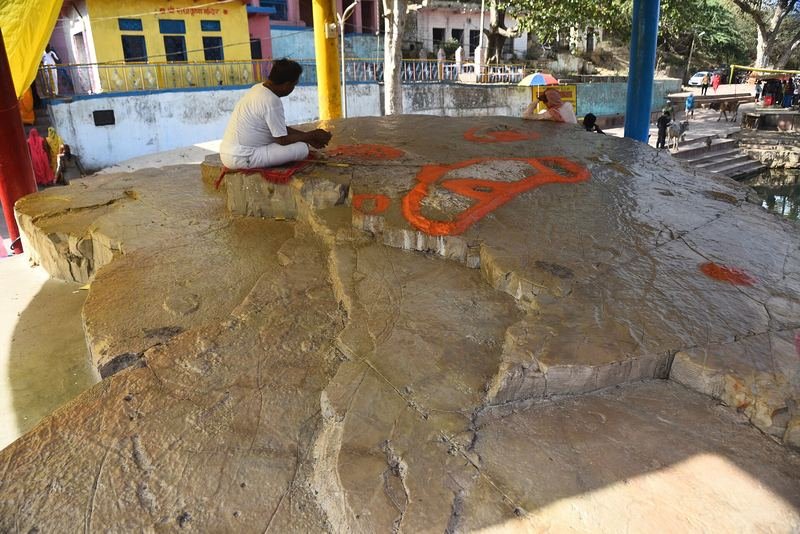
| A crow attacks Sita, and Ram punishes it with a blade of grass charged as a Brahma weapon; Sita later tells Hanuman this as a token. The text places it at the foot of Chitrakuta, to the north-east, and says the crow was Indra's son. The name Jayant comes from later tellings. | Sundara Kanda 38 | Sphatik Shila, where footprints are shown |
Tulsidas's Ramcharitmanas sums up the Chitrakoot years in one line at the opening of the Aranya Kand: "Ram lived at Chitrakoot and did many deeds, sweet as nectar to hear."
रघुपति चित्रकूट बसि नाना। चरित किए श्रुति सुधा समाना॥
Where are these places today?
Most of the places tradition links to the Ramayana are within about 20 km of Ramghat, on both the Uttar Pradesh and Madhya Pradesh sides. Each name links to its card on our places to visit page, with hours and fees as published.
| Place | What tradition says | Side · from Ramghat |
|---|---|---|
| Kamadgiri | Pilgrims honour Kamadgiri, whose deity is Kamtanath, by walking the ~5 km parikrama around it. | UP and MP · in town |
| Ramghat | Ram, Sita and Lakshman are believed to have bathed here; the Tulsidas story below is told here. | Both banks · the starting point |
| Bharat Milap Mandir | The meeting of Ram and Bharat; footprints on the rock are believed to be theirs. | UP · on the parikrama path |
| Sphatik Shila | The crow episode; a rock believed to bear Ram's footprints. | MP · a short drive |
| Janki Kund | Sita is believed to have bathed in this stretch of the Mandakini. | MP · about 2 km |
| Sati Anusuya | The hermitage of Atri and Anusuya, where the Mandakini is believed to rise. Sati Anusuya: reported badly hit by the August 2026 flood — we confirm it is open before your trip. | MP · about 15–16 km |
| Bharat Koop | The district website says Bharat placed the holy waters for Ram's coronation in this well, on the sage Atri's advice. | UP · about 20 km |
| Hanuman Dhara | A spring believed to have cooled Hanuman after the burning of Lanka. Steps or ropeway: see our Hanuman Dhara guide. | MP |
| Gupt Godavari | Caves with two stone "thrones" of Ram and Lakshman, by local tradition. Closed since late September 2026 after a rock fall. Latest status: is Gupt Godavari open now? | MP · about 18 km |
In Tulsidas's telling, as the district website summarises it, Ram meets the sage Valmiki, who advises him to live at Chitrakoot; a Valmiki Ashram at Lalapur is linked to this by tradition. We have not checked it ourselves yet — ask us. Looking for a "Ram Darbar" in Chitrakoot? See our Ram Darbar guide.
Tulsidas and Chitrakoot
Tradition at Ramghat holds that Tulsidas, after searching for Ram in Ayodhya and Kashi, had darshan of Ram and Lakshman here, with Hanuman's help — Hanuman appearing as a parrot. That is how the district website tells it. A well-known traditional doha belongs to this story; we have not traced where it was first written down:
चित्रकूट के घाट पर भई संतन की भीर।
तुलसीदास चंदन घिसें तिलक देत रघुबीर॥
One thing is often mixed up: the Ramcharitmanas was not simply written at Ramghat. Tulsidas began it in Ayodhya on Ram Navami in 1574 (Vikram Samvat 1631), and it is described as composed at Ayodhya, Varanasi and Chitrakoot. Rajapur, about 40 km from Chitrakoot on the Yamuna, is traditionally regarded as his birthplace. Near Janki Kund, Manas Darshan at Tulsi Peeth shows 16 scenes from the Ramcharitmanas with moving figures.

How can you see these places?
Almost every place on this page fits into two easy days by car. Day 1 covers Ramghat, Kamadgiri with Bharat Milap and Sphatik Shila; day 2 the Janki Kund side, Tulsi Peeth and Sati Anusuya (if open). Our Chitrakoot in 2 or 3 days plan has the timings and the elders' pace. For the parikrama itself — the 5 km path, the time it takes and tips for elders — see Kamadgiri parikrama: distance, time and route. If you want the stories told on the way, an English-speaking guide can join on request (₹1,000 per day; prices as of November 2026); your driver speaks Hindi.
In Chitrakoot, Ram is remembered as a forest exile; at the Ram Raja Temple in Orchha he is worshipped as a king. Our Orchha Ram Raja Temple guide covers that side of the story.
See the Ramayana places of Chitrakoot
The plan and the price in writing on WhatsApp
Send us your date, how many people are travelling (and whether any elders are coming) and your pickup point, and tell us which places on this page matter most to you. We reply with a plan and a fixed price in writing — usually within minutes, 7 am – 10 pm.
No WhatsApp? Send us an SMS and we will reply.
हिंदी में बात करें — WhatsApp करें या फ़ोन करें। सुबह 7 से रात 10 बजे तक, हर दिन।
Questions and answers
How many years did Ram stay in Chitrakoot?
Tradition in Chitrakoot holds that Ram, Sita and Lakshman spent about 11½ of their 14 years of exile here. The Valmiki Ramayana does not give a number; in it, Ram moves on after Bharat's visit. The district website and MP Tourism give about 11 to 11½ years, as tradition and folklore.
Where did Bharat meet Ram in Chitrakoot?
Tradition places the meeting at the Bharat Milap Mandir, on the Kamadgiri parikrama path on the Uttar Pradesh side, where rocks are believed to have melted when the brothers met. In the Valmiki Ramayana, Ram gives Bharat his sandals at the end of this visit (Ayodhya Kanda 112–113).
Where did the crow (Jayant) story happen?
The Valmiki Ramayana places it at the foot of Chitrakuta, to the north-east, and says the crow was Indra's son (Sundara Kanda 38); the name Jayant comes from later tellings. In Chitrakoot, tradition links the story to Sphatik Shila on the Mandakini, where footprints are shown.
Is the Mandakini mentioned in the Ramayana?
Yes. In the Valmiki Ramayana, Ram shows Sita the Mandakini at Chitrakuta (Ayodhya Kanda 95). The same text says Anasuya's penance made the Ganga (Jahnavi) flow there during a ten-year drought; local belief holds that this river is the Mandakini, which rises at the Sati Anusuya ashram.
Where did Tulsidas compose the Ramcharitmanas?
It is described as composed at Ayodhya, Varanasi and Chitrakoot; he began it in Ayodhya on Ram Navami in 1574. Tradition at Ramghat holds that he had darshan of Ram and Lakshman there, with Hanuman's help in the form of a parrot.
Why do pilgrims walk around Kamadgiri?
Pilgrims honour Kamadgiri, whose deity is Kamtanath, by walking the ~5 km parikrama around it. The district website says devotees seek the blessings of Kamtanath and Ram by circling the hill, with the Bharat Milap Mandir on the way.
Sources we checked (17 November 2026)
- Valmiki Ramayana, text and translation on valmikiramayan.net: Ayodhya Kanda 54, 56, 95, 112, 117; Aranya Kanda 11; Sundara Kanda 38.
- greenmesg, Valmiki Ramayana, Ayodhya Kanda: Atri and Anusuya's ashrama — sargas 117–119, Anasuya's counsel and gifts to Sita.
- Chitrakoot district website, "Chitrakoot Darshan" (page updated 2024) — the 11½-year tradition, Kamtanath and the parikrama, Bharat Koop, Sati Anusuya and the Mandakini, Hanuman Dhara, Gupt Godavari, and the Tulsidas story at Ramghat.
- MP Tourism, Chitrakoot — "eleven of their fourteen years", according to folklore.
- Wikipedia, "Ramcharitmanas" — begun in Ayodhya in 1574; composed at Ayodhya, Varanasi and Chitrakoot.
- Amar Ujala, 11 November 2026 — Gupt Godavari caves closed; ANI via Asianet, 4 September 2026 — flood damage at Sati Anusuya.
- Place details (sides, distances, hours) come from our places to visit and timings, fees and distances pages, which list their sources.